Chemical Analysis
Spectrometer testing (OES) to verify manganese, carbon, silicon and other alloying elements against the specified grade.

Built for demanding Industrial Applications. Explore Manganese Steel Casting solutions from Bhanu Special Castings.
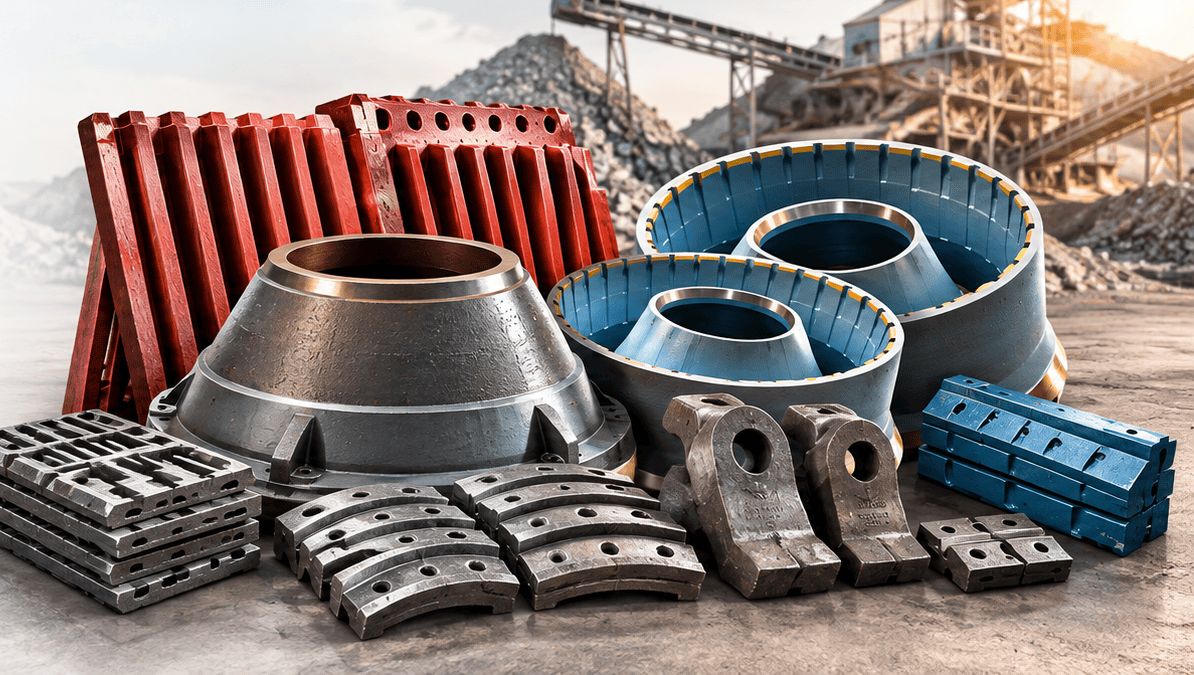
Manganese steel castings are wear-resistant components manufactured from high-manganese alloy steel, typically designed for applications involving repeated impact, crushing, compression and abrasive contact.
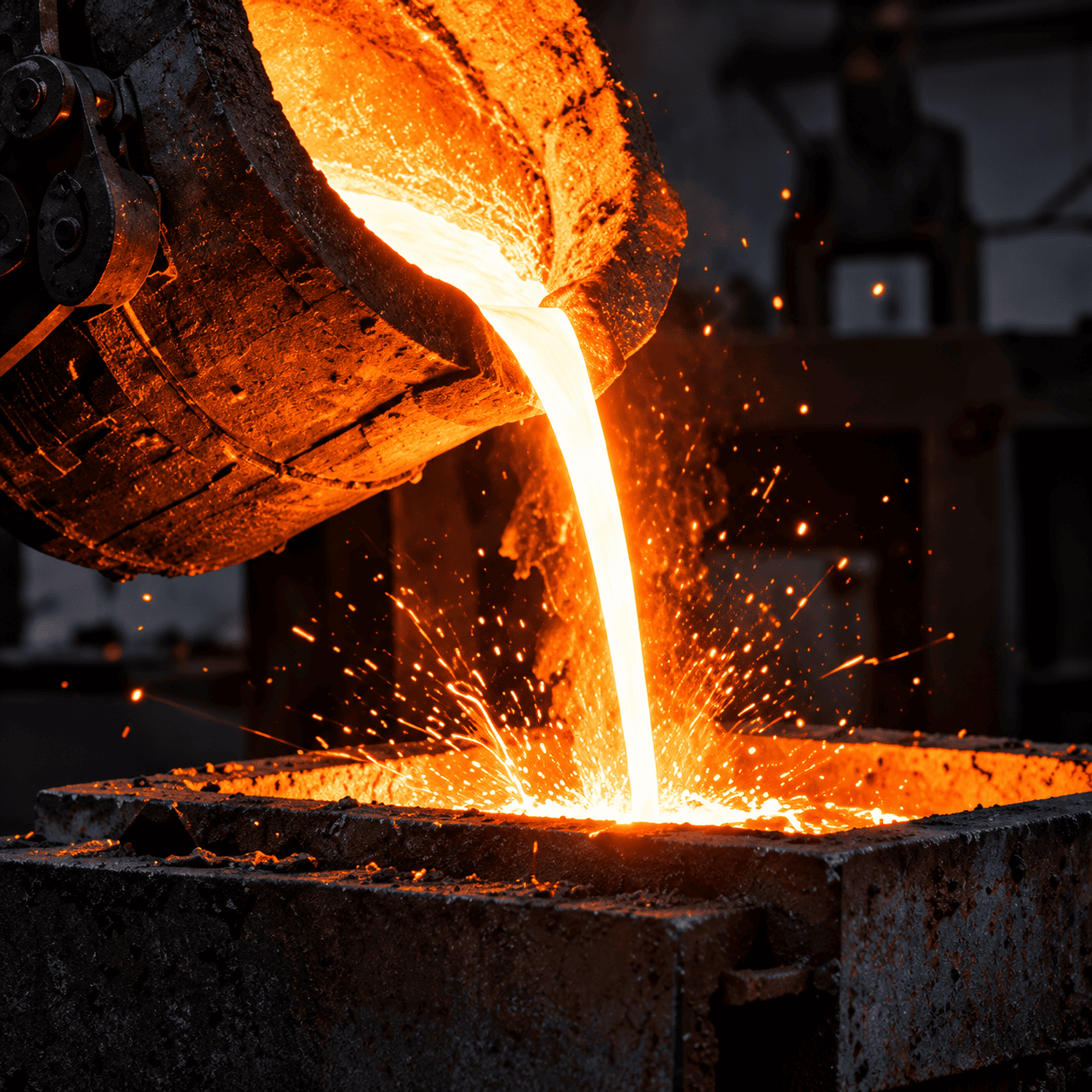
Conventional Hadfield steel generally contains approximately 11–14% manganese and 1.0–1.4% carbon, with exact chemistry depending on the selected material grade.
Following appropriate solution heat treatment and rapid cooling, the material develops a predominantly austenitic microstructure. Its distinguishing characteristic is the ability to increase surface hardness through plastic deformation during service.
PART 6 ───
Select a country to explore its manganese steel grades and indicative chemical composition.
| Grade | C % | Si % | Mn % | P % | Cr % | Ni % | Mo % |
|---|---|---|---|---|---|---|---|
| Gr 1 | 1.10–1.30 | ≤0.50 | 12.0–14.0 | ≤0.10 | — | — | — |
| Gr 2 | 0.90–1.05 | ≤0.50 | 11.5–14.0 | ≤0.10 | — | — | — |
| Gr 3 | 1.05–1.35 | ≤0.80 | 11.5–14.0 | ≤0.10 | 1.5–2.5 | — | — |
| Gr 4 | 0.70–1.30 | ≤0.80 | 11.5–14.0 | ≤0.10 | — | 3.0–5.0 | — |
| Gr 5 | 1.05–1.45 | ≤0.80 | 11.5–14.0 | ≤0.10 | — | — | 1.8–2.1 |
| Gr 6 | 1.05–1.35 | ≤0.80 | 16.0–19.0 | ≤0.10 | — | — | — |
| Gr 7 | 1.05–1.35 | ≤0.80 | 11.5–14.0 | ≤0.10 | 1.5–2.5 | — | 1.0–2.0 |
ⓘ Reference values carried over from your JSX draft, not yet fully validated against the official standards. Use the authorized edition for contractual chemical composition limits.
| Grade | C % | Mn % | Si % | P % | Cr % | Ni % | Mo % |
|---|---|---|---|---|---|---|---|
| A | 1.05–1.35 | ≥11.0 | ≤1.00 | ≤0.07 | — | — | — |
| B-1 | 0.90–1.05 | 11.5–14.0 | ≤1.00 | ≤0.07 | — | — | — |
| B-2 | 1.05–1.20 | 11.5–14.0 | ≤1.00 | ≤0.07 | — | — | — |
| B-3 | 1.12–1.28 | 11.5–14.0 | ≤1.00 | ≤0.07 | — | — | — |
| B-4 | 1.20–1.35 | 11.5–14.0 | ≤1.00 | ≤0.07 | — | — | — |
| C | 1.05–1.35 | 11.5–14.0 | ≤1.00 | ≤0.07 | 1.5–2.5 | — | — |
| D | 0.70–1.30 | 11.5–14.0 | ≤1.00 | ≤0.07 | — | 3.0–4.0 | — |
| E-1 | 0.70–1.30 | 11.5–14.0 | ≤1.00 | ≤0.07 | — | — | 0.9–1.2 |
| E-2 | 1.05–1.45 | 11.5–14.0 | ≤1.00 | ≤0.07 | — | — | 1.8–2.1 |
| F | 1.05–1.45 | 6.0–8.0 | ≤1.00 | ≤0.07 | — | — | 0.9–1.2 |
ⓘ Reference values carried over from your JSX draft, not yet fully validated against the official standards. Use the authorized edition for contractual chemical composition limits.
| Designation | Material No. | C % | Si % | Mn % | P % | S % | Alloy |
|---|---|---|---|---|---|---|---|
| G-X 120 Mn 13 | 1.3401 | 1.10–1.30 | ≤0.50 | 12.0–14.0 | ≤0.07 | ≤0.04 | — |
| G-X 120 MnCr 13-2 | — | 1.10–1.30 | ≤0.50 | 12.0–14.0 | ≤0.07 | ≤0.04 | Cr: 1.5–2.5 |
| G-X 120 MnMo 7-1 | — | 0.80–1.00 | ≤0.50 | 6.0–8.0 | ≤0.07 | ≤0.04 | Mo: 0.9–1.2 |
| G-X 120 MnNi 13-3 | — | 0.70–1.00 | ≤0.50 | 12.0–14.0 | ≤0.07 | ≤0.04 | Ni: 3.0–4.0 |
ⓘ Reference values carried over from your JSX draft, not yet fully validated against the official standards. Use the authorized edition for contractual chemical composition limits.
| Grade | C % | Si % | Mn % | P % | S % | Notes |
|---|---|---|---|---|---|---|
| ZGMn13-1 | 1.05–1.35 | 0.30–0.80 | 11.0–14.0 | ≤0.06 | ≤0.04 | General grade |
| ZGMn13-2 | 1.05–1.35 | 0.30–0.80 | 11.0–14.0 | ≤0.06 | ≤0.04 | Controlled chemistry |
| ZGMn13-3 | 0.75–1.05 | 0.30–0.80 | 11.0–14.0 | ≤0.06 | ≤0.04 | Lower carbon |
| ZGMn13-4 | 0.90–1.20 | 0.30–0.60 | 11.0–14.0 | ≤0.06 | ≤0.04 | Impact applications |
| ZGMn13Cr2 | 1.00–1.30 | 0.30–0.80 | 11.0–14.0 | ≤0.06 | ≤0.04 | Cr-modified |
| ZGMn13MoRe | 0.90–1.30 | 0.30–0.80 | 11.0–14.0 | ≤0.06 | ≤0.04 | Mo / RE modified |
ⓘ Reference values carried over from your JSX draft, not yet fully validated against the official standards. Use the authorized edition for contractual chemical composition limits.
| Grade | C % | Si % | Mn % | P % | Notes |
|---|---|---|---|---|---|
| SCMnH1 | 0.90–1.05 | ≤0.80 | 11.0–14.0 | ≤0.07 | Standard grade |
| SCMnH2 | 1.05–1.20 | ≤0.80 | 11.0–14.0 | ≤0.07 | Standard Hadfield |
| SCMnH3 | 1.20–1.35 | ≤0.80 | 11.0–14.0 | ≤0.07 | Higher carbon |
| SCMnH11 | 1.05–1.20 | ≤0.80 | 11.0–14.0 | ≤0.07 | Chromium-modified |
| SCMnH21 | 0.70–1.10 | ≤0.80 | 11.0–14.0 | ≤0.07 | Molybdenum-modified |
ⓘ Reference values carried over from your JSX draft, not yet fully validated against the official standards. Use the authorized edition for contractual chemical composition limits.
PART 7 ───
OUR PRODUCTS & SUBPRODUCTS
Manganese steel castings are widely used in crushing, mining, quarrying and material-processing equipment. Each application requires components with suitable geometry, alloy chemistry, dimensional accuracy and wear characteristics.
Our product classification helps customers identify individual components and submit enquiries with their equipment specifications.
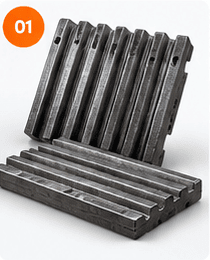
Jaw crusher wear components are designed to withstand compressive forces and repeated impact during primary crushing operations.
Fixed jaw plates, movable or swing jaw plates, corrugated jaw plates, standard tooth profiles, quarry tooth profiles, super tooth profiles, heavy-duty jaw dies and cheek plates.
Mn13, Mn18 and modified grades, subject to application and component specifications.
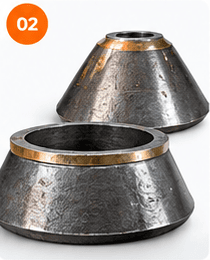
Cone crusher wear components form the crushing chamber and are exposed to compression, abrasion and repeated material contact.
Mantles, concaves, bowl liners, standard chamber liners, medium chamber liners, fine chamber liners, short-head liners and custom crushing profiles.
Mn13, Mn18, Mn18Cr2 and other application-specific alloys.
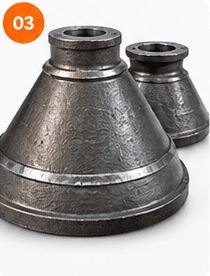
Gyratory crusher components are used in large-capacity crushing equipment, particularly in mining and mineral processing.
Gyratory mantles, concave segments, upper concave segments, middle concave segments, lower concave segments and crushing chamber liners.
High-manganese and modified manganese steel grades selected according to loading and wear conditions.
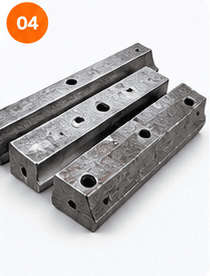
Impact crusher components experience high-speed contact with feed material and require careful alloy selection.
Blow bars, impact plates, breaker plates, apron liners, side liners and impact wear segments.
Manganese steel where impact conditions justify its use; high-chromium iron and martensitic steel are alternative materials for many blow-bar applications.
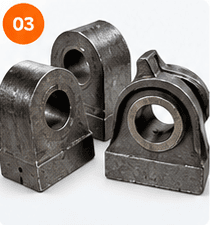
Hammer mill components are subjected to repetitive impact during size reduction of minerals and other industrial materials.
Crusher hammers, hammer heads, hammer mill liners, grate bars, breaker plates and side liners.
High-manganese steel for suitable impact applications; other wear-resistant alloys may be required depending on the equipment.
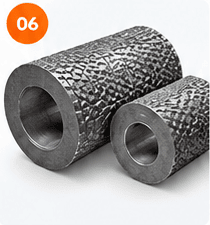
Roll crusher wear parts support controlled material reduction through compression and, in some designs, shearing action.
Roll shells, toothed roll segments, replaceable crushing teeth, roll wear segments and associated liners.
Application-dependent manganese steel or alternative wear alloys.
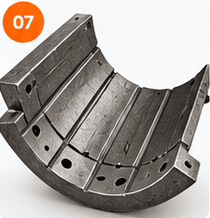
Grinding mill liners protect mill structures and influence the movement of grinding media and processed material.
Ball mill shell liners, rod mill liners, lifter bars, grate plates, end liners and discharge liners.
Manganese steel for suitable duties, along with other cast alloy and engineered liner materials.
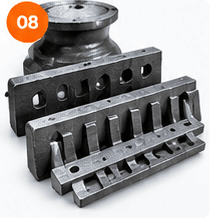
Mining and material-handling systems require components capable of handling impact, abrasive material flow and heavy operating loads.
Grizzly bars, chute liners, apron feeder pans, impact wear plates, selected bucket or dipper components and custom wear castings.
Manganese steel or alternative wear alloys depending on service conditions.
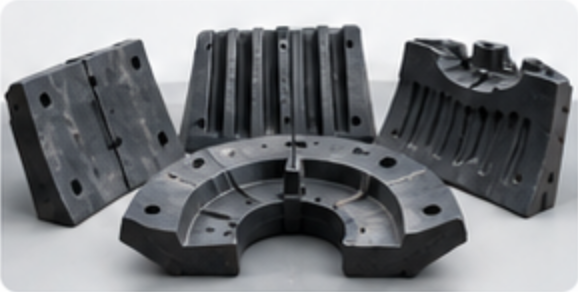
Custom Casting Solutions Based on Your Engineering Requirements. Every industrial application has unique loading conditions, equipment geometry and wear challenges. Custom castings can be developed using approved drawings, dimensional specifications, existing patterns or suitable component samples.
Component drawing, equipment model, material grade, approximate weight, quantity, operating conditions and special inspection requirements.
Material selection and inspection requirements agreed against the component application and purchase specification.
Metallurgy • Austenite • Carbides • Grain Structure
The performance of manganese steel is closely related to its internal microstructure. Chemical composition, casting conditions and heat treatment influence the phases and their distribution.
Conventional Hadfield manganese steel should have a predominantly austenitic microstructure after proper heat treatment, providing high toughness, ductility and work-hardening capacity.
Austenite is a face-centred cubic (FCC) structure stabilized by manganese, carbon and other alloying elements. The austenitic matrix provides excellent toughness, ductility and the ability to work-harden under impact.
Carbides may form during solidification and cooling. In the as-cast condition, they can appear within grains or along grain boundaries. Excessive or continuous carbide networks may reduce ductility, so proper solution heat treatment is essential.
Austenite with possible carbide segregation.
Dissolution of suitable carbides.
Retention of the desired austenitic condition.
Manganese steel consists of austenitic grains separated by grain boundaries. Grain size, segregation and grain-boundary phases influence strength, toughness and crack propagation.
Tough, ductile matrix with relatively low initial hardness.
Dislocations accumulate; deformation twinning may occur.
Higher surface hardness while retaining a tough core.
Metallographic examination helps identify undesirable carbide distribution, segregation and grain structure. It supports quality assurance, especially when heat-treatment effectiveness or material condition must be verified.
The microstructure of manganese steel plays a critical role in its toughness, work-hardening behavior and resistance to impact-related wear.
QUALITY ASSURANCE & INSPECTION
A dependable manganese steel casting must meet more than a chemical composition target. Quality also depends on casting soundness, heat treatment, dimensional conformity, surface condition and the inspection requirements agreed with the customer.
Comprehensive inspection and testing help ensure material integrity, dimensional accuracy and consistent performance in service.
Spectrometer testing (OES) to verify manganese, carbon, silicon and other alloying elements against the specified grade.
Verification of critical dimensions, profiles and fitting requirements as per drawings and specifications.
Identification of visible casting defects such as surface cracks, blowholes, misruns and other discontinuities.
Tensile, Brinell hardness and impact testing to evaluate strength, ductility and toughness, where specified.
Dye penetrant, ultrasonic or radiographic testing as applicable, to detect surface and internal discontinuities.
Microstructural verification to assess austenitic structure, grain boundaries, carbide distribution and heat-treatment effectiveness.
Heat numbers and records according to the agreed documentation system, including relevant test reports and certificates.
Testing methods and acceptance criteria depend on the applicable standard, customer specifications and available inspection facilities. Specialized tests may be performed when required.
Specific tests and certificates should be described as available from BSCPL only after confirmation.
REQUEST FOR QUOTATION (RFQ)
Looking for manganese steel wear components for your crusher, mining equipment or industrial application?
Share your technical requirements with Bhanu Special Castings. Include your component drawing, equipment model, preferred material grade and quantity to help our team review your enquiry.
Upload drawings or share technical details of your component.
Our team reviews your requirements and suggests suitable grades and options.
Receive a detailed quotation based on your specifications and required quantity.
Engineering support for your industrial and mining applications.
Share the applicable drawing, material grade and inspection requirements. Our team will review your enquiry and contact you to discuss the quotation.
Fill in the details below to request a quotation for manganese steel castings.

Designed to withstand heavy impact and repeated loading in demanding applications.
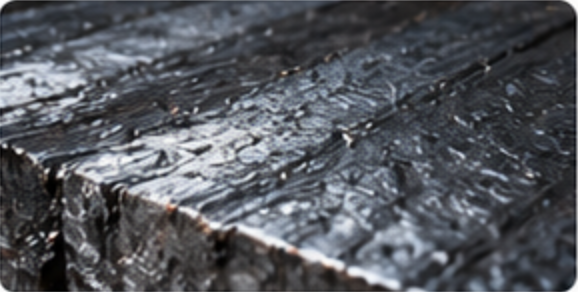
Surface hardness increases as the material undergoes repeated deformation.
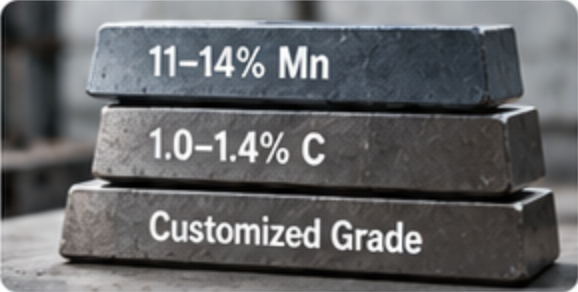
Composition and heat treatment can be selected according to service conditions.
Suitable for many crusher liner profiles and heavy industrial wear components.
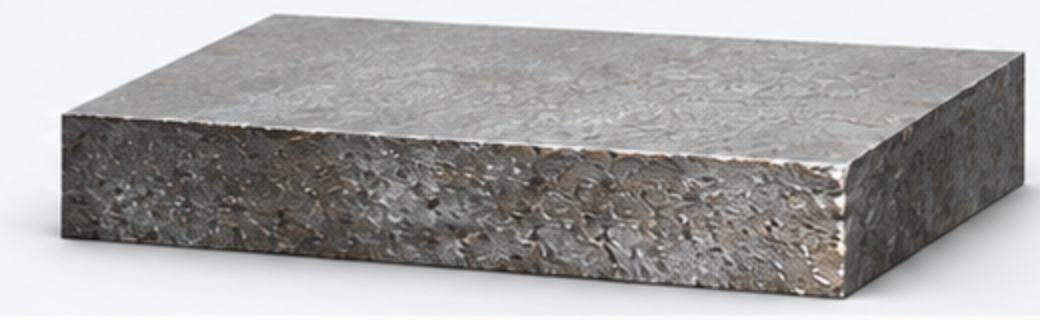
How Manganese Steel Becomes Harder During Service
One of the most valuable properties of austenitic manganese steel is its ability to work-harden. When crushing forces, impact loads or repeated deformation act on a manganese steel component, the surface undergoes strain-hardening. This increases resistance to further deformation and can improve wear performance in suitable service environments.
185–250
HBW, indicative
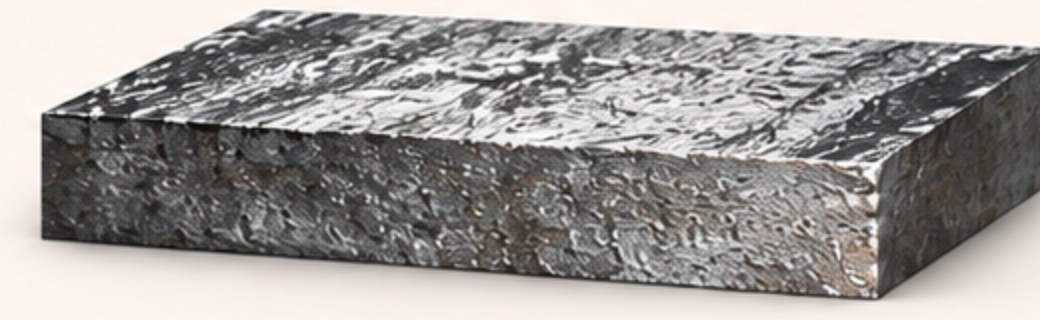
400+
HBW possible

In impact-loaded crushers, manganese steel develops a harder working surface while retaining a tough core. This combination helps resist cracking, deformation and abrasive wear during service.

Manganese steel is not automatically the best material for every abrasive environment. Low-impact sliding abrasion may favor alternative alloys such as high-chromium white iron or hardened alloy steels.
Key TakeawayHigher manganese content does not always mean better wear life. Correct material selection is more important than choosing the highest alloy percentage. | GRADE SELECTION DEPENDS ON: ⚙ Crusher type ◇ Feed material |
INTERNATIONAL STANDARDS & GRADE SPECIFICATIONS
Manganese steel castings are classified under different national and international material standards. These specifications define chemical composition limits, alloy modifications and applicable material requirements.
Understanding these standards helps manufacturers, equipment suppliers and industrial buyers identify suitable grades for their applications.
| Country / Region | Standard | Representative Grade Designations |
|---|---|---|
| 🇮🇳 India | IS 276 | Grades 1–7 |
| 🇺🇸 USA | ASTM A128 / A128M | A, B-1 to B-4, C, D, E-1, E-2, F |
| 🇩🇪 Germany | DIN / SEW designations | G-X 120 Mn 13, alloy variants |
| 🇪🇺 International / Europe | ISO 13521 | GX120Mn13 and related designations |
| 🇨🇳 China | GB/T 5680 | ZGMn13 series and alloy variants |
| 🇯🇵 Japan | JIS G 5131 | SCMnH series |
| 🇬🇧 United Kingdom | BS 3100 | BW10 |
| 🇫🇷 France | NF A32-058 | Z 120 M 12 |
| 🇮🇹 Italy | UNI designations | G X 120 Mn 12 |
| 🇦🇺 Australia | AS 2074 | H1A, H1B |
| 🇿🇦 South Africa | SABS 407 | Grade series |
| 🇷🇺 Russia | GOST 977 | 110G13L |
| 🇪🇸 Spain | UNE 36-253 | AM-X 120 Mn 12 and variants |
| 🇸🇪 Sweden | SS designations | 21 83 series |
| 🇳🇴 Norway | NS 1699 | St Mn 12 |
| 🇰🇷 South Korea | KS D 4101 | SCMnH |
ⓘ This table is a standards-navigation reference, not a declaration of exact grade equivalence, current edition validity or BSCPL certification. All rows require verification against the applicable standard and purchase specification before use.
You can edit text on your website by double clicking on a text box on your website. Alternatively, when you select a text box a settings menu will appear. your website by double clicking on a text box on your website. Alternatively, when you select a text box
FROM ENGINEERING TO DISPATCH How Manganese Steel Castings | Manufacturing high-quality manganese steel castings requires coordination between pattern development, mould preparation, melting, metallurgical control, heat treatment and final inspection. The process below is a proposed technical workflow. Specific BSCPL production procedures should be confirmed internally before describing them as universal company practice. |
01 ▤ Engineering Review & Material SelectionEvaluate the component drawing, operating conditions, dimensions, wear mechanism and customer requirements to identify the appropriate casting material. | 02 ▱ Pattern DevelopmentDevelop or inspect patterns according to component geometry, casting allowances, machining requirements and moulding method. | 03 ⚙ Moulding & Core PreparationPrepare moulds and cores using suitable moulding materials and processes, taking account of casting size, shape and surface-finish requirements. | 04 ♨ Charge Preparation & MeltingSelect and calculate the metallic charge and alloy additions. Melt the charge under controlled conditions appropriate for the selected manganese steel composition. |
05 ⚗ Chemical Composition VerificationEvaluate molten-metal chemistry against the applicable material specification and make permitted adjustments before casting. | 06 ↘ Molten Metal PouringPour molten steel into prepared moulds using a suitable pouring practice that considers temperature, casting geometry and mould requirements. | 07 ♨ Solidification, Cooling & ShakeoutAllow the casting to solidify and cool according to the established production procedure before removing the moulding material. | 08 ⚒ Fettling & Preliminary FinishingRemove gating and riser material where appropriate, clean the casting and perform preliminary finishing operations. |
09 ≋ Solution Heat Treatment & Water QuenchingApply the grade-appropriate solution treatment and rapid quenching process to develop the required austenitic structure and toughness. Exact temperatures, soaking times and cooling practices depend on the specification and casting section. | 10 ☑ Quality Inspection & TestingInspect the finished casting against applicable chemical, dimensional, visual and other agreed acceptance requirements. | 11 ▣ Final Finishing, Identification & DispatchComplete any specified machining, finishing, marking, documentation and packaging before delivery. |
ⓘ This is a general technical workflow for manganese steel castings. Items should be marked as BSCPL practice only after confirmation from the company’s production or catalogue records.
PART 9 ───── Mechanical & Physical Properties Typical Properties of |
| Property | Indicative value / characteristic |
|---|---|
| Conventional manganese content | Approximately 11–14% |
| Conventional carbon content | Approximately 1.0–1.4% |
| Ultimate tensile strength | Approximately 650–1,000 MPa |
| Yield strength | Approximately 350–450 MPa |
| Elongation | Approximately 20–50% |
| Elastic modulus | Approximately 190–210 GPa |
| Initial hardness | Approximately 185–250 HBW |
| Work-hardened surface hardness | Can exceed 400 HBW |
| Microstructure | Predominantly austenitic after suitable heat treatment |
| Impact resistance | High under appropriate service conditions |
| Ductility | Grade- and process-dependent |
| Magnetic behavior | Generally low magnetic response in fully austenitic condition |
| Density | Approximately 7.8–7.9 g/cm³ |
| Heat treatment | Grade-appropriate solution treatment and rapid quenching |
ⓘ General engineering reference only. These are not guaranteed BSCPL test results or contractual minimum properties.
EFFECT OF ALLOYING ELEMENTS
Alloying elements influence the structure, mechanical properties and wear behaviour of manganese steel castings.
C Carbon (C)Influences strength, work-hardening behavior, carbide formation and toughness. | Mn Manganese (Mn)Stabilizes the austenitic structure and contributes to the characteristic behavior of Hadfield steel. |
Cr Chromium (Cr)Used in modified compositions to influence wear and deformation characteristics. | Mo Molybdenum (Mo)May improve selected properties and assist alloy design for demanding casting sections. |
Ni Nickel (Ni)An austenite-stabilizing addition used in certain specialized compositions. | P Phosphorus (P)An impurity that requires control because excessive levels can adversely affect casting integrity. |
You can edit text on your website by double clicking on a text box on your website. Alternatively, when you select a text box a settings menu will appear. your website by double clicking on a text box on your website. Alternatively, when you select a text box
START YOUR PROJECT WITH US
Send your drawing, metal grade and number of pieces. Tell us how the part is used. Our team will review your needs and prepare a quote.
Bhanu Special Castings Private Limited makes steel and iron castings in Vijayawada. We began in 1998. We serve mines, crushers, cement plants, power plants and other industries across India. Send us your drawing or sample to discuss the part you need.
Get in touch for product information, casting requirements and technical enquiries.
Request Product Updates →© 2026 Bhanu Special Castings Private Limited. All Rights Reserved. | Privacy Policy